
The Man Who Recorded History: Inside the Aadam Jacobs Collection
Over 10,000 bootleg concert tapes. Nirvana before Nevermind. Pixies before fame. A Chicago devotee quietly preserved the underground — and now it’s free for all.
There is a house on the North Side of Chicago where time does not move quite like it does everywhere else. The walls are lined floor-to-ceiling with LP records. Boxes — dozens upon dozens of them — are stacked in rooms, in corridors, in corners, each one packed tight with cassette tapes. Some of these tapes are labeled in careful handwriting. Some are not labeled at all. But all of them carry the same secret: they contain live music that no label ever captured, no venue ever archived, no streaming platform ever licensed. They contain history, pressed into ferric oxide, slowly decaying — until now.
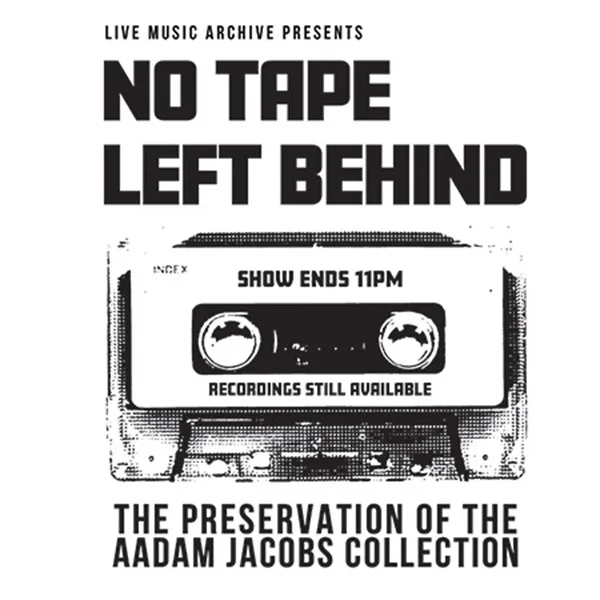
The man who built this archive is Aadam Jacobs. The collection is his name. And as of late 2025, it is finally, painstakingly, heroically available online — at the Internet Archive, free to stream, free to download, free to disappear into for days. For anyone who orbits the worlds of alternative music, post-punk archaeology, pre-fame recordings, and the underground circuits that shaped modern rock, this is not just a cultural resource. It is one of the most significant personal archives in American music history, hidden in plain sight for four decades.
From a Borrowed Dictaphone to 10,000 Shows

Jacobs did not begin as a visionary archivist. He began as a teenager who loved music and had no money. As a teen discovering music, Jacobs began taping songs off the radio. He eventually met someone who told him he could just take a tape recorder into a show and sneak it in, and he thought that was cool. So he got started. That first recording, sometime around 1984, was made with a Dictaphone he borrowed from his grandmother. The device was barely functional. The sound quality was rough. None of that mattered.
What followed was forty years of compulsive, methodical, radically generous obsession. The Chicago Tribune described him as a “ubiquitous local club presence” and “rabid fan.” Jacobs captured an estimated 30,000 music sets from at least 3,000 music acts. He recorded with increasingly sophisticated gear as the years went on — upgrading from borrowed Dictaphones to Sony Walkmans to proper field recorders — but the spirit never changed. He was not doing this for money. He was not doing this for fame. He was doing this because somebody had to.
Author Bob Mehr, who wrote about Jacobs in 2004 for the Chicago Reader, calls him one of the city’s cultural institutions. “He’s a character. I think you have to be, to do what he does,” Mehr said. “But I think he proved over time that his intentions were really pure.”
The Night Nirvana Walked Into Dreamerz
To understand the scope of what Jacobs built, you need to hold a single moment in your mind. On July 8, 1989, a young music fan named Aadam Jacobs, with a compact Sony cassette recorder in his pocket, went to see an up-and-coming rock band from Washington for their debut show in Chicago. After a blast of guitar feedback, 22-year-old Kurt Cobain politely announced to the crowd at the small club called Dreamerz: “Hello, we’re Nirvana. We’re from Seattle.” With that, the band launched into the riff-heavy first song, “School.”
This was more than two years before Nevermind. Before the haircuts. Before the magazine covers. Before the funeral. Nirvana at Dreamerz was a four-piece opening act, still finding the shape of what they were. And Jacobs was there, cassette rolling, capturing it — because that’s what he did every single week, at every club he could get into.
What makes this recording transcendent is not just the rarity. It is the rawness. The fact that nobody in that room knew they were watching something permanent. The fact that the band didn’t know either. Jacobs himself later told the Chicago Tribune, unsentimentally: “They were OK. They weren’t great.” That kind of honest indifference — recording not because something was already legendary, but simply because music deserved to be remembered — is the entire moral architecture of his collection.
The Full Scope: A Who’s Who of Underground Royalty
The Nirvana tape is the collection’s most talked-about artifact, but it would be a mistake to let it eclipse everything else. The depth of this archive is staggering precisely because it does not rely on a single crown jewel.

The collection features early-in-their-career performances from alternative and experimental artists like R.E.M., The Cure, The Pixies, The Replacements, Depeche Mode, Stereolab, Sonic Youth and Björk. There’s also a smattering of hip-hop, including a 1988 concert by rap pioneers Boogie Down Productions. Devotees of Phish were thrilled to discover that a previously uncirculated 1990 show by the jam band is included.
For readers of this magazine, who understand what it means to hear a band before the industry got hold of them, this list is almost hallucinogenic. Stereolab, playing Chicago clubs before Dots and Loops, before the Duophonic catalogue expanded into something critics had to build new vocabulary to describe. Sonic Youth in their ferocious pre-DGC years, playing to rooms where most of the audience was itself full of musicians. The Replacements — chaotic, brilliant, incapable of being bottled — caught in a 1986 Cabaret Metro set that Jacobs documented so precisely that recordings from his holdings were used to enrich The Replacements’ live release Not Ready for Prime Time: Live at the Cabaret Metro, recorded in 1986 and issued for Record Store Day 2024. A fan tape, four decades later, officialized by the band themselves. That is not nostalgia. That is validation.

WBEZ described Jacobs’s collection years ago as a hidden record of Chicago’s indie-rock era, with early tapes by Liz Phair, Smashing Pumpkins, Jeff Tweedy, New Order, Naked Raygun, Flaming Lips and Yo La Tengo. Beyond the famous names, there are hundreds of sets by smaller artists — local Chicago acts, touring bands who never broke through, and experimental groups who left no official trace. That is where the collection becomes something other than a fan site. It becomes an ethnographic document.
The Race Against Decay
None of this was inevitable. In fact, it almost didn’t happen at all.
Magnetic tape degrades. It is a material fact, not a metaphor. Decades in cardboard boxes, subject to temperature shifts and humidity, cause the binder on cassette tapes to break down, the oxide to shed, the audio to distort and ultimately vanish. Jacobs has known this for years. “I don’t have enough life left in me to digitize everything I have,” Jacobs said. “And it’s just decaying. So before everything falls apart, it needs to be digitized. There’s no sense in me holding onto the vast majority of what I have for potential release someday. So it’s best if it gets out of my hands, so that it can live on beyond me.”

The catalyst that moved this from paralysis to action was the 2023 documentary Melomaniac, directed by Katlin Schneider. The film premiered at the Chicago Underground Film Festival and won the Audience Favorite Award. Schneider worked on it for four years, capturing interviews with figures from Chicago’s 1980s and 1990s music scene, including owners of The Metro and Lounge Ax concert venues, musician Jon Langford, and former Trenchmouth drummer Fred Armisen. The film ended with the fate of the collection still unresolved. A volunteer with the Internet Archive saw it, reached out to Jacobs, and changed everything.
The online collection contained 171 audio recordings in January 2025 and grew to more than 2,300 by April 2026. The pace of growth reflects the sheer size of what remains. Volunteer Brian Emerick transfers the analog recordings into digital files. “Currently, I have 10 working cassette decks, and I run those all simultaneously,” Emerick explained. He estimates he has digitized about 5,000 tapes since late 2024 and expects the project to take several more years.
This is the scale we are dealing with. Not a weekend project. Not a grant-funded institutional initiative. A volunteer operation, run by people who believe that music history is worth saving, doing it one tape at a time.
What This Means for Underground Music History
There is a version of music history told by record labels, publicists, and Rolling Stone retrospectives. That version has gaps — enormous, structural gaps — where the underground lived and breathed and created the things that would later be called “influential.” The Aadam Jacobs Collection is a direct confrontation with those gaps.
When Sonic Youth played Chicago in 1985, nobody from a major label was watching. The venue didn’t film it. The band didn’t document it officially. But Jacobs was there with his Sony recorder, and now you can listen to it. This is what independent music scholarship looks like before institutions decide to care. It is done by obsessives, in the dark, with borrowed equipment, out of pure love.
In an era when institutional memory is often filtered through labels, streaming services and official archives, Jacobs’s cassettes show how much of music history depends on private citizens who save what others overlook. That sentence should be printed on the wall of every music archive in the world.
The question of copyright inevitably arises, and Jacobs addresses it with a pragmatist’s candor. Jacobs said the majority of the artists he recorded are pleased to have their work preserved. As for copyright concerns, he’s happy to remove recordings if requested, but added that only one or two musicians so far have asked that their material be taken down. “I think that the general consensus is, it’s easier to say I’m sorry than to ask for permission,” he said. Given that the archive is entirely non-commercial and that several artists have actively engaged with and even released material from it, this seems less like a legal grey area and more like a working consensus built on mutual respect.
How to Navigate the Collection
The Aadam Jacobs Collection lives at the Internet Archive under the Live Music Archive umbrella. Jacobs is frequently in regular contact with the volunteer team — more often, he jokes, than with his own family — helping fill in gaps in metadata. Every upload includes setlist information, recording equipment notes where available, and venue details. It is not just a dump of audio files. It is an archive in the genuine, scholarly sense of the word.
For the VBMGZN reader approaching this for the first time: start with the bands you know in their unexpected early form. Listen to Depeche Mode before Violator, when the synths were more abrasive and the pop ambition was still fighting with something weirder. Go to the Stereolab recordings and hear them in an American club context. Then follow the links sideways into the lesser-known acts, the local Chicago bands, the one-off shows by artists who vanished without leaving official documentation. That’s where the collection becomes genuinely irreplaceable.
Depeche Mode Live at Aragon Ballroom 1985-03-22
Approximately 2,500 recordings are currently available for free streaming and download, with a dedicated crew of audio engineers restoring the tapes using vintage equipment and modern mastering tools. The number grows every week. There is no subscription. There is no paywall. There is only the music, and the extraordinary fact that someone loved it enough to save it.
The Archive Is Open
Aadam Jacobs never wanted to be famous. He wanted the music to survive. By any measure, he has succeeded — and in doing so, he has given the global underground community something it didn’t know it had lost: its own memory, restored, digitized, and made free.
The collection is here. Go there. Stay a while. You will find yourself in rooms where history happened and nobody noticed — except one man with a tape recorder in his pocket, who understood that some things are worth keeping.
Leave a Reply