

Raw, Intimate, Unfiltered: Richard Kern and the Art of New York Transgression

By VBMGZN Editorial | Updated March 2026
There are photographers who document subcultures, and there are photographers who are the subculture. Richard Kern belongs to the second category — a Lower East Side native son whose Polaroids, Super 8 films, and relentless visual provocation didn’t observe New York’s underground so much as constitute it. Four decades on, his work remains one of the most precise and unsettling records of a city, a scene, and an ethos that no longer exists in quite the same form.
This is not a neutral biography. Kern’s work resists neutral readings. What follows is an attempt to map the full terrain of his practice — from No Wave cinema to iconic portrait photography — and to place it honestly within the cultural conversation it helped create.
Richard Kern and the New York Underground Photography Scene
To understand Richard Kern, you have to understand the geography of early-1980s Manhattan. The Lower East Side — Alphabet City specifically — was not yet a destination. It was cheap, dangerous, and largely ignored by mainstream cultural institutions. That neglect created the conditions for one of the most concentrated eruptions of experimental art in American history: No Wave cinema, hardcore punk, graffiti, performance art, and the early iterations of what would become the global underground art market.

Kern arrived in New York in the late 1970s from North Carolina, drawn by the same gravitational pull that brought Nick Zedd, Lydia Lunch, Kembra Pfahler, and dozens of others into the orbit of a neighbourhood that had effectively opted out of polite society. He began making photographs and films almost immediately — not as documentation, but as participation. The camera was an instrument of immersion, not observation.
What distinguished Kern from the wave of art school graduates colonising SoHo at the same moment was an absolute absence of ironic distance. His photographs did not comment on transgression. They enacted it.
From No Wave to Cinema of Transgression: Kern’s Film Origins
The Cinema of Transgression is the formal name for something that was initially just a group of people making films in apartments with borrowed equipment and no distribution strategy. The term was coined by Nick Zedd in his 1985 Cinema of Transgression Manifesto, a document as much provocation as programme — calling for film that would “go beyond all limits set or prescribed by taste, morality or any other convention.”
Kern was among its central practitioners. Films like The Right Side of My Brain (1984), Fingered (1986), and Submit to Me (1985) circulated through downtown clubs, alternative spaces, and eventually international underground film circuits. They starred the scene’s own inhabitants — Lydia Lunch, Lung Leg, Tommy Turner — and they operated in a register that deliberately made comfort impossible.

The films were not polished. They were not meant to be. The Super 8 grain, the direct sound, the unmediated confrontation between camera and subject — these were aesthetic choices, not technical limitations. Kern understood intuitively what many formally trained filmmakers spent careers trying to learn: that restriction can generate intensity. The roughness of his films is inseparable from their power.
What the Cinema of Transgression established, and what Kern embodied within it, was the principle that underground art’s primary obligation was not to its audience’s comfort but to its own internal logic. It was a position that would prove increasingly difficult to maintain as the downtown scene became a commodity in the 1990s — but while it lasted, it produced work of genuine and lasting consequence.
“You Killed me First” R. Kern, first film.1985 (CC / Archive.org)
Richard Kern’s Polaroids: Intimacy, Provocation and Raw Aesthetics
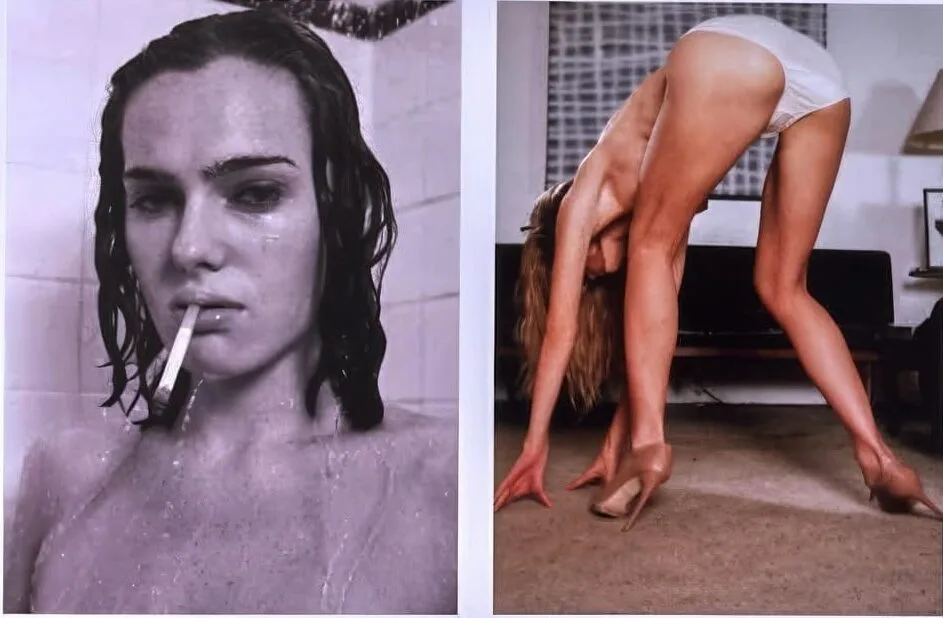
The Polaroid camera is, in many ways, the ideal instrument for Kern’s sensibility. Instant, irreversible, and unmediated by the darkroom’s interpretive distance, the Polaroid produces images that exist as objects before they exist as photographs. Each one is singular. There is no negative, no possibility of reprinting, no space for retrospective editing.
Kern’s Polaroid practice developed in parallel with his filmmaking and has outlasted it as his primary mode. The images are intimate in the literal sense: most are made in small rooms, at close range, with subjects who are known to the photographer. The intimacy is not domesticated. The photographs are frequently confrontational, sexually charged, and constructed around a negotiated tension between vulnerability and agency that has made them genuinely controversial in ways that much supposedly provocative art never achieves.
His books — New York Girls (1997), Kern’s Collected (1998), Looker (2012), among others — established his Polaroid work as a coherent body rather than a collection of individual images. Read sequentially, they trace an evolving investigation into the relationship between camera, photographer, and subject — and specifically into the question of who controls the terms of that relationship.
This is where serious critical engagement with Kern’s work becomes necessary and where lazy dismissal does real disservice. The women who appear in his photographs are not passive recipients of the male gaze in any straightforwardly theoretical sense. Many are collaborators, performers, artists in their own right who chose the encounter and shaped its terms. The photographs document a negotiation, and the tension they generate comes precisely from the refusal to resolve it into a comfortable reading.
The cult photographer and no-wave filmmaker Richard Kern talks to John-Paul Pryor about Lydia Lunch, Sonic Youth, self-harming super-freaks and the search for a new kind of beauty. Click to read this interview
The Visual Anti-Establishment: Power, Vulnerability and the Unfiltered Body
The body is Kern’s persistent subject. Not the body as ideological construct or critical object — though his work has generated substantial academic analysis on those terms — but the body as the irreducible fact of human presence. What happens when you point a camera at someone and they look back?
The most significant quality of Kern’s best work is the refusal of aestheticisation in any conventional sense. There are no flattering angles deployed to diffuse the subject’s humanity into visual pleasure. The images are, deliberately, uncomfortable to hold in the eye. They ask something of the viewer that most photography does not: an honest acknowledgement of what you are doing when you look at another person through a representation.
This is the anti-establishment position encoded in the work itself, not in any biographical narrative about the artist’s outsider status. The images function as a critique of the photographic conventions they appear to inhabit — the nude, the portrait, the documentary — by performing those conventions while systematically undermining their operations.
Kern has cited Diane Arbus as a formative influence, and the connection is illuminating. Both photographers are concerned with the ethics of looking — with what the camera takes from its subjects and what it gives back. The difference is temperamental: where Arbus approaches her subjects with a complicated tenderness, Kern approaches his with a complicated antagonism that is, paradoxically, its own form of respect.

Richard Kern’s Influence on Photography, Film and Visual Subcultures
The direct lineage from Kern’s practice to subsequent generations of underground and art photographers is well documented. His influence on the aesthetic vocabulary of alternative fashion photography, on the visual culture of zines and independent publishing, and on the broader project of reclaiming explicit imagery from both commercial pornography and fine art mystification is traceable and substantial.
Less often acknowledged is the institutional influence. Kern’s consistent presence in publications including Vice, Purple, and Self Service — alongside gallery exhibitions in New York, Berlin, and Tokyo — demonstrated that work originating in the absolute margins of cultural production could achieve broad circulation without compromising its terms. This was not a small demonstration in the 1990s and 2000s, when the relationship between underground and mainstream culture was being renegotiated in real time.
The Cinema of Transgression’s influence on experimental film has been extensively documented by scholars including Jack Sargeant, whose Deathtripping: The Extreme Underground (1995, updated 2008) remains the definitive account. What Sargeant’s work makes clear is that the movement’s significance lies not in any individual film but in the establishment of a model: that cultural production outside institutional frameworks was not merely possible but preferable, and that the resulting work carried an authenticity unavailable to more formally supported art.
Is Richard Kern Still Working? His Legacy in Contemporary Art
Kern has remained continuously active. His photographic practice has evolved through digital formats while retaining the immediate, unmediated quality that defined his Polaroid work. He has exhibited internationally into the 2020s, and his back catalogue has been subject to increasing critical re-evaluation as the cultural distance from the downtown scene of the 1980s has grown large enough to permit historical perspective.
The re-evaluation is not uniformly positive, nor should it be. Kern’s work raises questions that genuine critical engagement cannot dissolve into admiration. But the questions it raises — about representation, consent, the ethics of looking, the relationship between artistic transgression and actual harm — are the right questions, and the fact that his images still generate them is itself evidence of their durability.
What is certain is that the documentary record Kern created of the New York underground between roughly 1980 and 2000 is irreplaceable. The scene he photographed and filmed has vanished under the weight of gentrification and commodification. His images are, among other things, a historical archive of a moment when a neighbourhood and a culture existed in a specific and temporary relationship to power. That alone would justify the work’s preservation.
The photographs and films do more than document, however. They argue. They insist on their own terms. In an era when images are produced at a volume that has effectively eliminated the possibility of any single image claiming sustained attention, Kern’s refusal of ease — his insistence that looking should cost the viewer something — is not merely historically significant.
It is necessary.

Frequently Asked Questions About Richard Kern
What is Richard Kern known for? Richard Kern is known for his transgressive Polaroid photography, his underground Super 8 films made in 1980s New York, and his central role in the Cinema of Transgression movement. His work is characterised by raw intimacy, provocation, and an unflinching examination of the body and underground subcultures.
What is the Cinema of Transgression? The Cinema of Transgression was a New York underground film movement of the 1980s, named in Nick Zedd’s 1985 manifesto. It deliberately rejected mainstream cinema conventions in favour of shock, sexuality, and anti-establishment provocation. Kern was one of its central figures alongside Zedd, Lydia Lunch, Kembra Pfahler, and Tommy Turner.
Is Richard Kern still active as a photographer? Yes. Richard Kern has remained active as a photographer well into the 2020s, continuing to produce work exhibited internationally and published in books and magazines. His practice has evolved through digital formats while retaining the immediate quality of his Polaroid work.
How did Richard Kern influence underground photography? Kern’s influence lies in his democratisation of the Polaroid as a serious artistic medium, his blurring of the line between documentary and art photography, and his establishment of an aesthetic vocabulary — raw, intimate, unposed — that influenced generations of photographers working outside mainstream commercial contexts.
Where can I see Richard Kern’s work? Kern’s work has been published in numerous books including New York Girls, Kern’s Collected, and Looker, and is accessible through gallery exhibitions internationally. His Cinema of Transgression films are available through specialist distributors and underground film archives.
VBMGZN covers music, culture, and cinema from the margins. If this piece resonated, explore our guides to Asian independent cinema, the underground rave cultures of China, and the Berlin techno scene through Sven Marquardt.

The Man Behind the Lens
Prepare your trip to discover New York’s underground Scene

Leave a Reply