
Cinema Under the Caudillo: The Spanish Films That Outlasted the Regime
Francisco Franco ruled Spain for nearly four decades. Between 1939 and his death in November 1975, his regime imposed one of Western Europe’s most suffocating cultural apparatuses: a censorship board with the power to cut, ban, rewrite, or simply bury any film deemed subversive, immoral, or ideologically dangerous. The Catholic Church sat alongside Falangist bureaucrats on those boards. Their pencils moved quickly.
And yet.
What emerged from those forty years was not silence. It was something far stranger and more enduring: a body of cinema that learned to speak in code, to hide its most radical ideas inside folk tale, fable, grotesque comedy and elliptical allegory. The directors who worked in Spain during this period — Juan Antonio Bardem, Luis García Berlanga, Víctor Erice, Carlos Saura, Fernando Fernán Gómez, Edgar Neville and others — developed a filmic language of extraordinary sophistication, precisely because they had no choice. Constraint, when it does not crush a talent entirely, has a way of sharpening it to a knife’s edge.
This is a guide to thirteen of those films. Not simply a ranking — but a reading. A map of how Spanish filmmakers navigated terror, bureaucratic obstruction and ideological surveillance, and produced masterpieces anyway.
Before the Code: Fantasy and Shadow in the Early Regime (1944–1951)
La Torre de los Siete Jorobados (Edgar Neville, 1944)

It would be a mistake to look at the earliest years of Francoism and expect only propaganda. Edgar Neville — aristocratic, cosmopolitan, a man who had worked in Hollywood and befriended Buster Keaton — gave Spanish cinema something it had no framework to suppress: a Gothic horror-comedy set in a subterranean Madrid populated by hunchbacks and criminals. La torre de los siete jorobados is simultaneously escapist and deeply weird, a film whose surrealist undertow reflects a sensibility fundamentally at odds with the regime’s piety and rigidity. Neville was never an obvious dissident, which is precisely what made him useful: he could make the bizarre feel unthreatening while planting something irreducible in the viewer’s imagination. The film’s phantasmagoric underground city reads, in retrospect, as a perfect metaphor for the Spain that official culture refused to acknowledge — a world existing beneath the paved-over surface of the new order.

La Calle Sin Sol (Rafael Gil, 1948)

Rafael Gil spent much of his career making films the regime found comfortable — religious epics, literary adaptations, safe commercial pictures. La calle sin sol is the exception that defines him. Set in the dark alleys of Barcelona’s Barrio Chino, it is Spanish noir at its most unvarnished: poverty, prostitution, moral collapse — all rendered with a visual bleakness that owed a genuine debt to Italian neorealism. That Gil managed to get this film made and distributed remains a small miracle of timing and nerve. It documented a Spain the regime preferred to pretend did not exist, and in doing so created a precedent — that the urban underclass, invisible to official culture, could be the subject of serious cinema.
Surcos (José Antonio Nieves Conde, 1951)

If La calle sin sol was uncomfortable, Surcos was actively scandalous. Nieves Conde — himself a Falangist, which gave him a degree of ideological cover — made a film about rural families migrating to Madrid and being destroyed by the city: crime, prostitution, the collapse of traditional values, an ending without redemption. The regime’s own censorship board was split. Some saw in it a warning against abandoning the rural idyll; others recognized it as a devastating indictment of the economic conditions Francoism had created. It was reluctantly approved and became a landmark. Nieves Conde had used the regime’s own ideology as a Trojan horse — and produced, almost accidentally, one of the most honest social documents in Spanish film history.
The New Spanish Cinema and the Grammar of Resistance (1955–1964)
Muerte de un Ciclista (Juan Antonio Bardem, 1955)

Juan Antonio Bardem was a Communist who somehow worked openly in Franco’s Spain, and his 1955 film remains one of the great works of European melodrama — and one of the great acts of political courage in Spanish film history. Muerte de un ciclista begins as a simple moral thriller: a bourgeois couple kills a cyclist in a hit-and-run and must live with the consequences. But Bardem’s real target is the Spanish upper class itself — its complicity, its comfort, its willingness to let the vulnerable die rather than endanger its own position. The censors saw a melodrama. Audiences saw themselves.
At the Cannes Film Festival that year, it won the FIPRESCI Prize. Spain, for a moment, was on the international map — and not for reasons the regime had planned. Bardem and his collaborator Luis García Berlanga had already, that same year, published the Salamanca Conversations: a blistering internal critique of Spanish cinema as “politically useless, socially false, intellectually inferior, aesthetically worthless and industrially crippled.” It was an extraordinary act of public defiance. Bardem would be arrested the following year during the production of Calle Mayor. He kept working.
Plácido (Luis García Berlanga, 1961)

If Bardem was the conscience of Spanish cinema, Berlanga was its anarchic, savage id. Plácido — nominated for the Academy Award for Best Foreign Language Film in 1962 — dismantles Francoist charity with surgical brutality. The premise is a Christmas campaign in a provincial city: wealthy families take in a poor person for dinner, enacting performative generosity while the actual poor are shuffled, humiliated and fundamentally unheard. Berlanga’s signature device — the long, chaotic ensemble shot in which multiple conversations compete simultaneously — creates a portrait of social hypocrisy so dense it almost passes as documentary.
Working again with screenwriter Rafael Azcona, who would become one of the defining voices of Spanish dissident cinema, Berlanga had crafted something the censors apparently mistook for festive comedy. That misreading is part of the film’s genius: it moves so fast, in so many directions at once, that its cruelty is almost invisible until the final frames.
El Cochecito (Marco Ferreri, 1960)

The Italian director Marco Ferreri came to Spain in the late 1950s and made, with Azcona’s script, one of the most genuinely disturbing films in the Spanish canon. An elderly man, desperate to join his disabled friends’ wheelchair fraternity, obtains his own motorized chair by increasingly extreme means — culminating in mass familicide. El cochecito was the kind of pitch-black grotesque that made censors uncertain: was it a film about the cruelty of modernity? The loneliness of old age? Or something far more nihilistic? Ferreri didn’t stay long enough to clarify. He returned to Italy, where he would continue to make films that made institutions profoundly uncomfortable. What he left behind in Spain was a template for corrosive dark comedy — and a demonstration that foreign filmmakers, briefly insulated from local consequence, could go further than any Spaniard safely could.
Historias de la Radio (José Luis Sáenz de Heredia, 1955)

Not every film on this list operated through subversion. Historias de la radio, directed by the regime-aligned Sáenz de Heredia — who had made a hagiographic documentary about Franco himself — is included here precisely because it demonstrates something important: even within the Francoist mainstream, genuine craft was possible. An anthology film structured around radio broadcasts and human-interest stories, it became one of the most commercially successful Spanish films of the decade. Its significance is sociological as much as artistic: it documents the texture of everyday life in mid-Francoist Spain with an accuracy that more ideologically committed filmmakers sometimes sacrificed for allegory. Sáenz de Heredia made the regime’s Spain feel inhabited — by real people, with real preoccupations — and that, in its own way, is an act of documentary honesty.
La Vida por Delante (Fernando Fernán Gómez, 1958)

Fernando Fernán Gómez is one of the most protean figures in Spanish cultural history — actor, playwright, novelist, director of extraordinary idiosyncrasy.
La vida por delante is his breakthrough as a filmmaker: a warm, gently satirical comedy about a young lawyer navigating the absurdities of modern Spanish life. Against the solemnity of official culture, Fernán Gómez offered something quietly subversive in its very ordinariness — characters who worried about rent, about finding work, about making a marriage survive. In refusing to ennoble or moralize, in treating domestic frustration as a worthy subject for cinema, he was already doing something the regime’s cultural hierarchy found difficult to classify and therefore difficult to stop.
El Extraño Viaje (Fernando Fernán Gómez, 1964)

With El extraño viaje, Fernán Gómez reached something altogether darker and more extraordinary. Based loosely on a real criminal case — the so-called crimen de Mazarrón — the film follows a group of provincial siblings whose isolation and pathology curdle into madness and violence, set against the backdrop of 1960s Spain’s grotesque social stagnation. It is a film of genuine horror, though Fernán Gómez wraps it in comedy long enough that the horror arrives as a genuine shock. The censors sat on it for two years before allowing release. When it finally reached audiences, critics and viewers alike found it difficult to classify. That difficulty is itself part of its greatness: it refuses the categories available to it and invents its own.

La Hora Incógnita (Julio Coll, 1963)

Less celebrated than others on this list, La hora incógnita by Julio Coll is a film that deserves wider recovery and reassessment. A genre-inflected thriller structured around the existential dread of nuclear annihilation, it occupied an uncomfortable space between entertainment and genuine metaphysical anxiety. Coll used genre conventions as Berlanga used comedy: as a container for material the censors would have refused in a more declarative register. The film’s terror is not simply about the bomb; it is about living in a country sealed off from the world, where information is controlled and ambient fear is the atmosphere everyone breathes without naming it. As a document of the Cold War filtered through a specifically Spanish claustrophobia, it has no real equivalent in the national cinema.
The Allegorical Masters — Cinema as Memory and Resistance (1973–1976)
Ana y los Lobos (Carlos Saura, 1973)

By the early 1970s, Carlos Saura had become the central figure of Spanish cinema’s most explicitly allegorical phase. Working repeatedly with producer Elías Querejeta and actress Geraldine Chaplin, Saura developed a formal language of extraordinary precision: enclosed spaces, fractured memory, the family as a microcosm of the authoritarian state. Ana y los lobos is, on its surface, a story about a foreign woman who takes a job as governess in a wealthy Spanish family and encounters three profoundly disturbed brothers who embody religious fanaticism, military brutality and repressed sexuality respectively.
The allegory is not subtle — but its power comes from how completely Saura commits to it, and from how viscerally the film renders each pathology. This is not a film that winks at its own symbolism. It inhabits it, until the violence it has been building toward arrives with an inevitability that functions as both dramatic and political argument. The censors initially banned it. It was eventually released and became, in Spain and internationally, a defining work of the nuevo cine español.

El Espíritu de la Colmena (Víctor Erice, 1973)

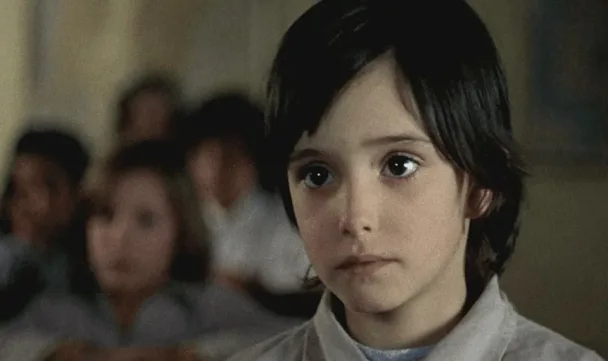
Víctor Erice directed only three features in his entire career. El espíritu de la colmena was the first, and it remains one of the most perfectly realized films in any language, from any era. Set in a Castilian village in 1940 — the year after Franco’s victory, when the silence of defeat had just settled over the landscape — it follows a young girl named Ana who, after watching James Whale’s Frankenstein at a traveling cinema, becomes convinced the monster is real and alive somewhere in the surrounding countryside. Around her, the adults move through their postwar lives in a fog of defeat and unspoken grief that Erice renders with heartbreaking delicacy.
The censors found nothing to cut. They had looked for a political argument and found only a child’s eyes and a beehive. What they missed — what audiences around the world have continued to discover — is an entire civilization’s trauma, encoded in a girl’s face, in the amber light of a Castilian autumn, in the long silences of a marriage that has survived something neither partner can name. Ana Torrent’s performance is among the great achievements of child acting in cinema history. Erice has never made anything quite like it again. Neither has anyone else.
Cría Cuervos (Carlos Saura, 1976)

Shot in the final months of the Franco regime — the dictator died in November 1975, and the film was released in 1976 — Cría cuervos is Saura’s most intimate and formally audacious work. Again, Ana Torrent is at its center, now playing a girl who believes she may have caused her father’s death and who moves through a world of grief, adult secrets and fractured temporality. The film’s structural innovation — past and present bleeding into one another, the adult Ana (played by Geraldine Chaplin) appearing as a kind of spectral memory of her childhood self — creates a meditation on how a country carries its own trauma across generations.
It won the Special Jury Prize at Cannes in 1976. By then, the regime was over. But Saura had made a film that refused to celebrate the opening of a new Spain: it was a reckoning, a film about what it meant to have grown up inside a particular silence, and about the impossibility of separating personal grief from political history. The title — “Raise Ravens” — comes from a Spanish proverb: Cría cuervos y te sacarán los ojos. Raise ravens, and they will pluck out your eyes. Spain had raised ravens. Saura wanted to look at them clearly.


What This Cinema Tells Us — A Critical Conclusion
The thirteen films surveyed here share a common condition: they were made inside a system explicitly designed to prevent the kind of truth they contain. What they demonstrate, collectively, is something political theory understands but that cinema proves viscerally — that censorship, when it fails to silence artists entirely, produces not silence but code. And code, once broken by an audience willing to read it, creates a bond between filmmaker and viewer that direct speech never quite achieves. The Franco regime spent four decades trying to control what Spaniards saw and thought. The films on this list are its most eloquent, most lasting refutation.
These directors were not a unified movement. They held different ideological positions, worked in different genres, and had complicated relationships with the institutions they were navigating. Bardem was a card-carrying Communist; Nieves Conde was a Falangist who made a neorealist masterpiece almost by accident; Berlanga was a political anarchist who used farce as his primary weapon; Erice was a poet who preferred silence to argument. What they shared was a refusal to let the available conditions determine what was possible.
The cage is gone. The films remain.
Frequently Asked Questions — Spanish Cinema Under Franco
What was the censorship system in Francoist Spain? From 1937 onward, the Franco regime operated a formal state censorship board (Junta de Censura) with authority over all films made or distributed in Spain. Scripts required prior approval, and finished films were subject to cuts and classification. The board was influenced heavily by the Catholic Church and Falangist ideology, targeting sexual content, political criticism, non-Catholic religious expression and any representation of Spain’s social conditions deemed damaging to the regime’s image.
How did Spanish filmmakers get subversive content past the censors? Through allegory, genre convention, temporal displacement, and the strategic use of humor and fantasy to obscure political content. Directors like Berlanga embedded social criticism in comedy; Erice and Saura used childhood perspective and fractured memory to make their subjects seem personal rather than political. Some films were still banned or cut despite these strategies — Ana y los lobos was initially prohibited, and El extraño viaje was held for two years.
Which Spanish films of this era were recognized internationally? Plácido (1961) received an Academy Award nomination for Best Foreign Language Film. Muerte de un ciclista (1955) won the FIPRESCI Prize at Cannes. Cría cuervos (1976) won the Special Jury Prize at Cannes. El espíritu de la colmena (1973) won the Golden Shell at San Sebastián and has since appeared on multiple international critical lists of the greatest films ever made.
Did any filmmakers face direct repression under the regime? Yes. Juan Antonio Bardem was arrested in 1956 during production of Calle Mayor, an incident that drew international attention and protest. Other filmmakers faced project cancellations, denial of filming permits and sustained bureaucratic obstruction. Luis Buñuel, arguably Spain’s greatest filmmaker, chose exile and made his most celebrated work in Mexico and France, unable to work in his own country for decades.
Is Spanish cinema of the Franco era taught internationally? Increasingly, yes. El espíritu de la colmena and Cría cuervos are now staples of university film curricula across Europe and the Americas. The broader body of work — Berlanga’s comedies, Bardem’s melodramas, the early Noir of Gil and Nieves Conde — remains less widely distributed and studied than it deserves, particularly outside Spain and France.

Leave a Reply